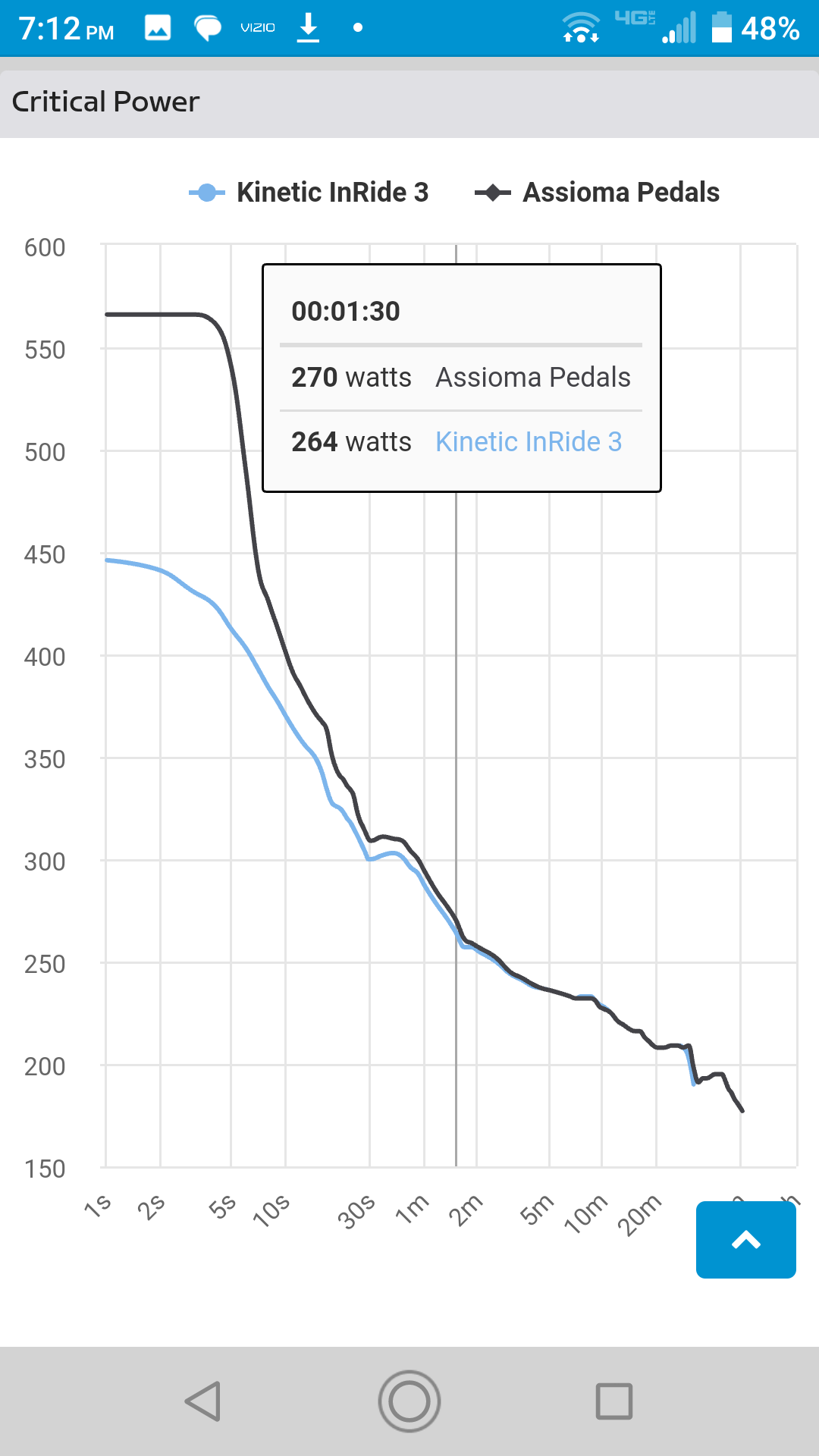
That’s with a wheel on dumb trainer that reports power so the short intervals are always reported less by the trainer at the same time the pedals are over reporting.
Which is better for accuracy?
That’s with a wheel on dumb trainer that reports power so the short intervals are always reported less by the trainer at the same time the pedals are over reporting.
Which is better for accuracy?
Genuine question. If you dont cheat or change the length of the cranks, would that be a better option ?
I would think that products that are specially made for power could be better than trainers who arent really build for racing and high watts.
GCN even mentioned in one of their videos that a trainer who does 500 watts max is good enough since hardly anyone goes over that.
And seeing a lot of comments that cranks and pedals arent any good for power. Is than everyone riding outside with them being lied to by their devices ?
Assuming you don’t cheat assioma’s are great. They tend to over estimate very short duration power (1s to 10s) but are great across longer duration.
The two problems with zwift is (a) intentional cheating and (b) Zwift will “fill in the blank” if you stop pedaling. This is mostly a zwift thing (probably to help with drop outs). It can make a real difference to have 2-3seconds extra at peak sprint to win a race.
For the Flux or other entry level trainers… probably use the assioma’s still. I don’t agree with GCN because a trainer that can only read to 500w is probably not as accurate as it should be, or will have a wider range of accuracy.
There is obviously a benefit of consistency inside and outside for some folks.
Hmm… I have one leg much weaker than the other and I can still get to 590 watts briefly.
I wouldn’t trust a trainer than only reads to 500w.
I use Assioma pedals and they are fine - I’m not using them in a way to take benefit of their shortcomings - I just want accurate overview of my power and power balance.
I watched the GCN video that you’re referring to. Although I appreciate that they are promoting people buying affordably priced gear, I think they should have emphasized that the trainer is perfectly adequate for steady Zone 2 and Sweet Spot style training (and probably even VO2-max for most people, if they don’t care about super accurate data) only.
It is not adequate for racing, because most people will regularly spike power above 500W at least momentarily multiple times.
My crank length is set correctly to 175mm (Canyon XL Endurace frame). I can always see it as I calibrate my Assioma’s in the app before every ride (I know it’s not strictly necessary). So the divergence in power readings is not driven by a wrong crank setting
I have a similar issue using Zwift hub and Garmin vectors. The zwift hub is over-reading by 3-5%. But at least it is a constant % across the entire power curve for me. I trust my pedals as I used to have a taxc neo 2t and ride a wattbike in work, and saw that pedals, neo 2t and wattbike were pretty consistent.
In free rides at zone 2, the pedals and zwift hub appear really consistent. The problem only seems to appear when racing. For a short trial, in erg mode, the pedals and zwift hub appear consistent too.
I have a 1x bike. I changed the chainring from 48t to 44t. When I did a race the power difference was close to 10%. This is what first drew my attention to the differences.
I am going to experiment with different levels of trainer difficulty and virtual/real shifting to see if any of that helps.
It is a real shame that zwift hub does not have a factory spin down feature